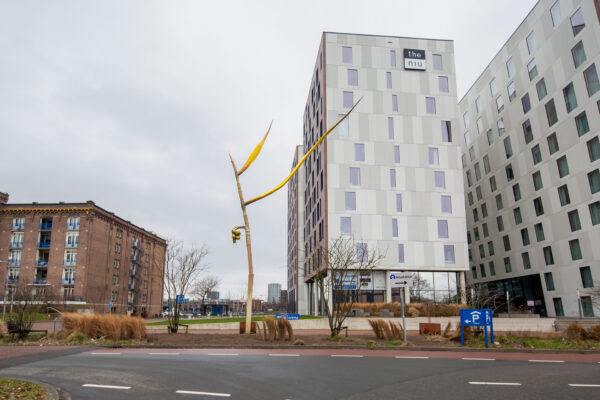
On Thursday 19 March, the official opening was celebrated on Cruquiuseiland of five new artworks by visual artist James Beckett. Spread across the island, five reed stems of approximately twelve metres high now stand. The sculptures refer to the history of the area, which from the sixteenth century was known as the ‘Rietlanden’ (Reed Lands), and make visible how the past can be seen in the new layout of the area. The project was realised in collaboration with TU Delft and startup Tree Composites, and was made possible by the Amsterdam Fund for the Arts, the Mondriaan Fund, Amvest Vastgoed B.V., DEKA Development Foundation and PurpleAir.
Design, materials and realisation In 2020, an art committee — comprising residents, developers, the municipality and the Stadscuratorium — drew up an artistic vision for the Cruquius area. This called for a cohesive series of five artworks across the island. Following a selection procedure, James Beckett’s design was chosen. In 2023, Beckett presented his final design. The construction makes use of innovative, lightweight and strong materials assembled from various components, including recycled plastic bottles. The artworks are located at five sites: at the inlet harbour on the Zeeburgerkade (Graft 1), on the Archiefstraat (Graft 2), on the Cruquiusweg (Graft 3), near the Locomotiefstraat (Graft 4) and near the Brandslangstraat (Graft 5).
James Beckett, artist: “As a research-driven artist with a strong interest in industrial heritage and the urban environment, I wanted to approach these artworks as portraits of this place: of what has happened here, what is unfolding now, and what is yet to come. The reed stems serve as a kind of pinboard, bringing together past, present and future — with references to industry and trade, but also to climate change and the rise of Smart Cities.”
Artworks that make the past visible The reed stems refer to the history of Cruquius, where reed fields once lay and industry later emerged. From a distance they appear to be ordinary reed stems, but up close you can see that exotic fruits and leaves hang from them, referencing goods imported via the Cruquius harbour. Objects are also attached to the stems that make the history of the area visible. The colours of the artworks refer, among other things, to the former Sigma paint factory. In this way, the artworks connect the former marshland and industrial area with the current and future Cruquius.
Art as part of area development The artworks form part of the renewal of the Cruquius area. In the coming years, approximately 1,700 homes and 18,000 square metres of commercial space will be added. These five artworks give the new city district a recognisable identity.
Further background information can be found via a QR code at www.graft1-5.nl. See also: www.amsterdam.nl/projecten/cruquiusgebied/nieuws/kunstwerken/